Territorial's Garlic Russian Red
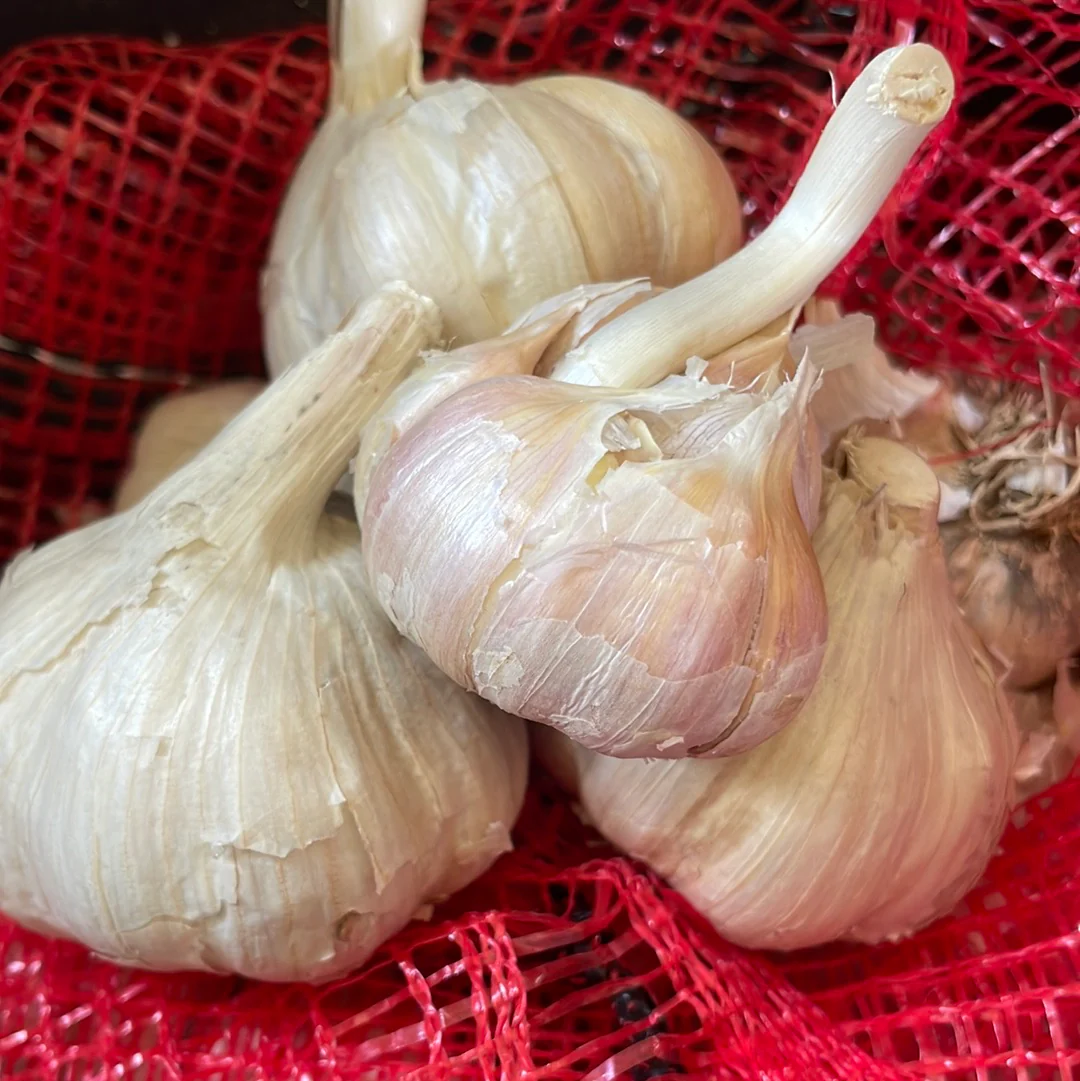
"Mid-season, Rocambole type. If a flavor-forward garlic is your jam, then this heirloom will suit you very well. Spicy, medium-hot and enduring when raw, the taste is all strong garlic with a subtly sweet aftertaste when cooked. Very cold-hardy and productive, the plants deliver big, colorful, reddish-purple blushed and striped heads with easy-to-peel cloves.
Growing great garlic is quite easy. Few pests bother garlic and with some basic guidelines, just about any home gardener can experience success.
Garlic prefers a rich, well-drained soil and does not do well in dense soils with low fertility. Separate the cloves just prior to planting. Plant the cloves 4-6 inches apart, covering them with 1-2 inches of soil. In northern areas, garlic should be planted in October and in the South it is planted from November through January. When spring growth begins, fertilize and water as needed. As harvest approaches, watering should be less frequent in order to avoid molding or staining the cloves. Cut off woody seed stems at the top leaf to redirect energy to the bulb. Harvest when at least 3 green leaves remain on the stem. Tie the plants in small bundles and dry in a cool, dark location."- from Territorial's label
Following taken directly from Territorial's website:
Culture
• Garlic thrives in rich, well-drained soil with a pH between 6.0-7.0
• Work in 1 inch layer of compost, 1/2 cup of bone meal, 1/2 cup TSC's Complete fertilizer per 5 row feet
• When spring growth begins: water to keep the soil slightly moist, and fertilize with Age Old Grow or TSC's Complete fertilizer
• As harvest approaches: water less to avoid molding or staining
• Hardnecks: cut off any flowering stems (scapes) at the top leaf to redirect energy to the bulb; scapes can be used like green onions
Direct Sowing
• In Northern regions, garlic is best planted by the end of October, or 6-8 weeks before the ground freezes
• Southern regions may plant as late as March
• Separate the cloves of garlic just prior to planting, keeping as much skin on as possible
• Plant cloves pointed end up
• Mulch with clean straw or leaves to 4 inches
Insects & Diseases
• Common insects: onion thrips, stem & bulb nematodes
• Insect control: Pyrethrin, 5–7 year crop rotation
• Common diseases: Gray mold/Botrytis, rust
• Disease prevention: 5–7 year crop rotation, avoid soggy soil
Harvest & Storage
• Harvest when the top 4-5 leaves are slightly green and lower leaves are dry
• Begin checking for mature bulbs in late June
• Each green leaf represents one layer of covering over the bulb in the ground
• Tie the plants in small bundles and dry in a cool, shaded, well-ventilated location for about 3-4 weeks
• After curing is done, cut foliage and roots from bulbs and store in mesh bags
• Softnecks: you can keep leaves on and braid the whole plant
"Mid-season, Rocambole type. If a flavor-forward garlic is your jam, then this heirloom will suit you very well. Spicy, medium-hot and enduring when raw, the taste is all strong garlic with a subtly sweet aftertaste when cooked. Very cold-hardy and productive, the plants deliver big, colorful, reddish-purple blushed and striped heads with easy-to-peel cloves.
Growing great garlic is quite easy. Few pests bother garlic and with some basic guidelines, just about any home gardener can experience success.
Garlic prefers a rich, well-drained soil and does not do well in dense soils with low fertility. Separate the cloves just prior to planting. Plant the cloves 4-6 inches apart, covering them with 1-2 inches of soil. In northern areas, garlic should be planted in October and in the South it is planted from November through January. When spring growth begins, fertilize and water as needed. As harvest approaches, watering should be less frequent in order to avoid molding or staining the cloves. Cut off woody seed stems at the top leaf to redirect energy to the bulb. Harvest when at least 3 green leaves remain on the stem. Tie the plants in small bundles and dry in a cool, dark location."- from Territorial's label
Following taken directly from Territorial's website:
Culture
• Garlic thrives in rich, well-drained soil with a pH between 6.0-7.0
• Work in 1 inch layer of compost, 1/2 cup of bone meal, 1/2 cup TSC's Complete fertilizer per 5 row feet
• When spring growth begins: water to keep the soil slightly moist, and fertilize with Age Old Grow or TSC's Complete fertilizer
• As harvest approaches: water less to avoid molding or staining
• Hardnecks: cut off any flowering stems (scapes) at the top leaf to redirect energy to the bulb; scapes can be used like green onions
Direct Sowing
• In Northern regions, garlic is best planted by the end of October, or 6-8 weeks before the ground freezes
• Southern regions may plant as late as March
• Separate the cloves of garlic just prior to planting, keeping as much skin on as possible
• Plant cloves pointed end up
• Mulch with clean straw or leaves to 4 inches
Insects & Diseases
• Common insects: onion thrips, stem & bulb nematodes
• Insect control: Pyrethrin, 5–7 year crop rotation
• Common diseases: Gray mold/Botrytis, rust
• Disease prevention: 5–7 year crop rotation, avoid soggy soil
Harvest & Storage
• Harvest when the top 4-5 leaves are slightly green and lower leaves are dry
• Begin checking for mature bulbs in late June
• Each green leaf represents one layer of covering over the bulb in the ground
• Tie the plants in small bundles and dry in a cool, shaded, well-ventilated location for about 3-4 weeks
• After curing is done, cut foliage and roots from bulbs and store in mesh bags
• Softnecks: you can keep leaves on and braid the whole plant
Description
"Mid-season, Rocambole type. If a flavor-forward garlic is your jam, then this heirloom will suit you very well. Spicy, medium-hot and enduring when raw, the taste is all strong garlic with a subtly sweet aftertaste when cooked. Very cold-hardy and productive, the plants deliver big, colorful, reddish-purple blushed and striped heads with easy-to-peel cloves.
Growing great garlic is quite easy. Few pests bother garlic and with some basic guidelines, just about any home gardener can experience success.
Garlic prefers a rich, well-drained soil and does not do well in dense soils with low fertility. Separate the cloves just prior to planting. Plant the cloves 4-6 inches apart, covering them with 1-2 inches of soil. In northern areas, garlic should be planted in October and in the South it is planted from November through January. When spring growth begins, fertilize and water as needed. As harvest approaches, watering should be less frequent in order to avoid molding or staining the cloves. Cut off woody seed stems at the top leaf to redirect energy to the bulb. Harvest when at least 3 green leaves remain on the stem. Tie the plants in small bundles and dry in a cool, dark location."- from Territorial's label
Following taken directly from Territorial's website:
Culture
• Garlic thrives in rich, well-drained soil with a pH between 6.0-7.0
• Work in 1 inch layer of compost, 1/2 cup of bone meal, 1/2 cup TSC's Complete fertilizer per 5 row feet
• When spring growth begins: water to keep the soil slightly moist, and fertilize with Age Old Grow or TSC's Complete fertilizer
• As harvest approaches: water less to avoid molding or staining
• Hardnecks: cut off any flowering stems (scapes) at the top leaf to redirect energy to the bulb; scapes can be used like green onions
Direct Sowing
• In Northern regions, garlic is best planted by the end of October, or 6-8 weeks before the ground freezes
• Southern regions may plant as late as March
• Separate the cloves of garlic just prior to planting, keeping as much skin on as possible
• Plant cloves pointed end up
• Mulch with clean straw or leaves to 4 inches
Insects & Diseases
• Common insects: onion thrips, stem & bulb nematodes
• Insect control: Pyrethrin, 5–7 year crop rotation
• Common diseases: Gray mold/Botrytis, rust
• Disease prevention: 5–7 year crop rotation, avoid soggy soil
Harvest & Storage
• Harvest when the top 4-5 leaves are slightly green and lower leaves are dry
• Begin checking for mature bulbs in late June
• Each green leaf represents one layer of covering over the bulb in the ground
• Tie the plants in small bundles and dry in a cool, shaded, well-ventilated location for about 3-4 weeks
• After curing is done, cut foliage and roots from bulbs and store in mesh bags
• Softnecks: you can keep leaves on and braid the whole plant